Customer First Newsletter – November 2024

WINTERIZATION AND FREEZE PREVENTION

In Texas, the winter season typically offers milder conditions, with fewer extreme weather events. Nevertheless, it’s essential to be prepared for the possibility of sudden and severe cold fronts that can catch us off guard. This is particularly crucial for homes and businesses in areas like Houston, where structures may not be adequately equipped to withstand a hard freeze. In this newsletter, we’ll remind you of the potential damage that can occur to your pipes during these cold snaps and share the measures we take to safeguard your facilities, ensuring smooth operations even in freezing conditions.

FREEZING TEMPERATURES VS HARD FREEZES

When the temperature drops below the freezing point of 32 degrees Fahrenheit, it’s considered freezing. Usually, brief episodes of freezing temperatures don’t lead to pipe or facility damage. However, when temperatures plummet below 30 degrees Fahrenheit and persist for more than eight hours, it’s classified as a hard freeze. During a hard freeze, water in exposed lines and irrigation backflow preventers freezes, potentially causing harm to equipment and instrumentation in water and wastewater facilities.

It’s important to note that when water freezes, it expands, which can result in broken pipes, water loss, and costly repairs. Additionally, there may be secondary expenses, including the replacement of damaged flooring, sheetrock, furniture, and other possessions. Furthermore, galvanized pipes may not burst during a freeze, but the expansion can cause the galvanizing to separate from the pipe, creating an area for corrosion to start, which may ultimately lead to leaks.

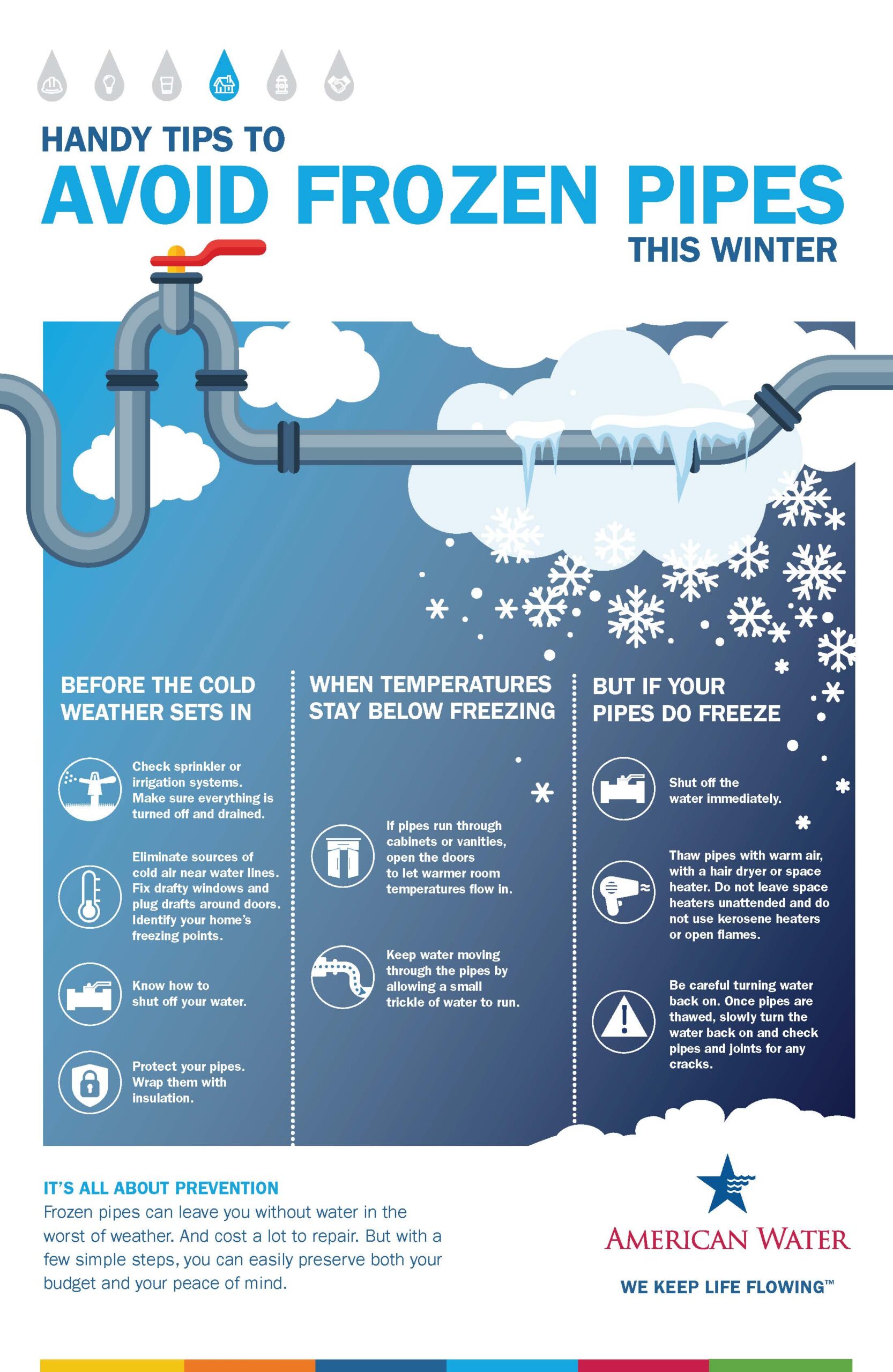
To ensure the protection and uninterrupted operation of our customers’ facilities during a hard freeze, we take a range of preventive measures. We closely monitor weather reports, drain lines, and turn off water to outdoor faucets and other exposed areas. Furthermore, we educate our customers on how to prepare for a hard freeze and the steps they can take to minimize the risk of damage to their facilities.

HOW TO PREPARE YOUR HOME

To prepare your home for freezing temperatures, consider the following steps:

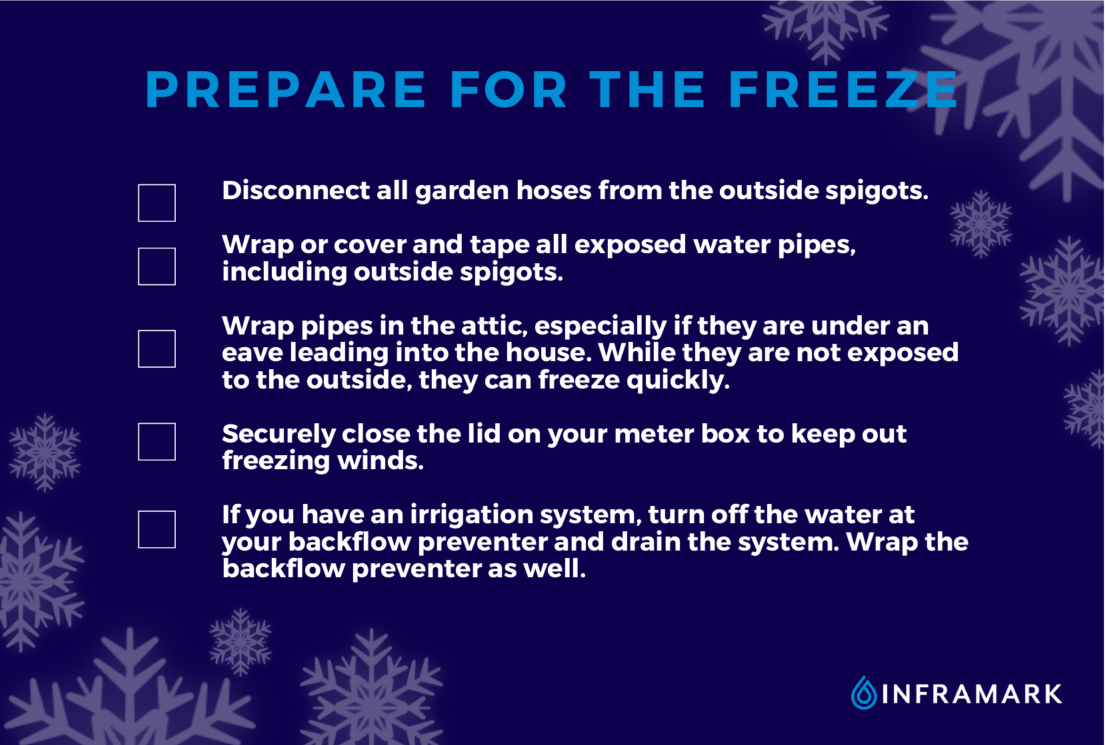
  • Disconnect all garden hoses from outside spigots. If you forget to drain them, avoid moving them during freezing temperatures as they may become brittle and crack.
  • Wrap or cover all exposed water pipes and outside spigots, then secure them with tape. Most home improvement stores offer tape, foam wrapping, and other products for this purpose. Purchase supplies early, as they tend to sell out quickly when a hard freeze is imminent.
  • Insulate pipes in the attic, especially those under eaves leading into the house, as they can freeze quickly.
  • Ensure that all lids on your water meter boxes are securely closed to prevent freezing winds from entering.
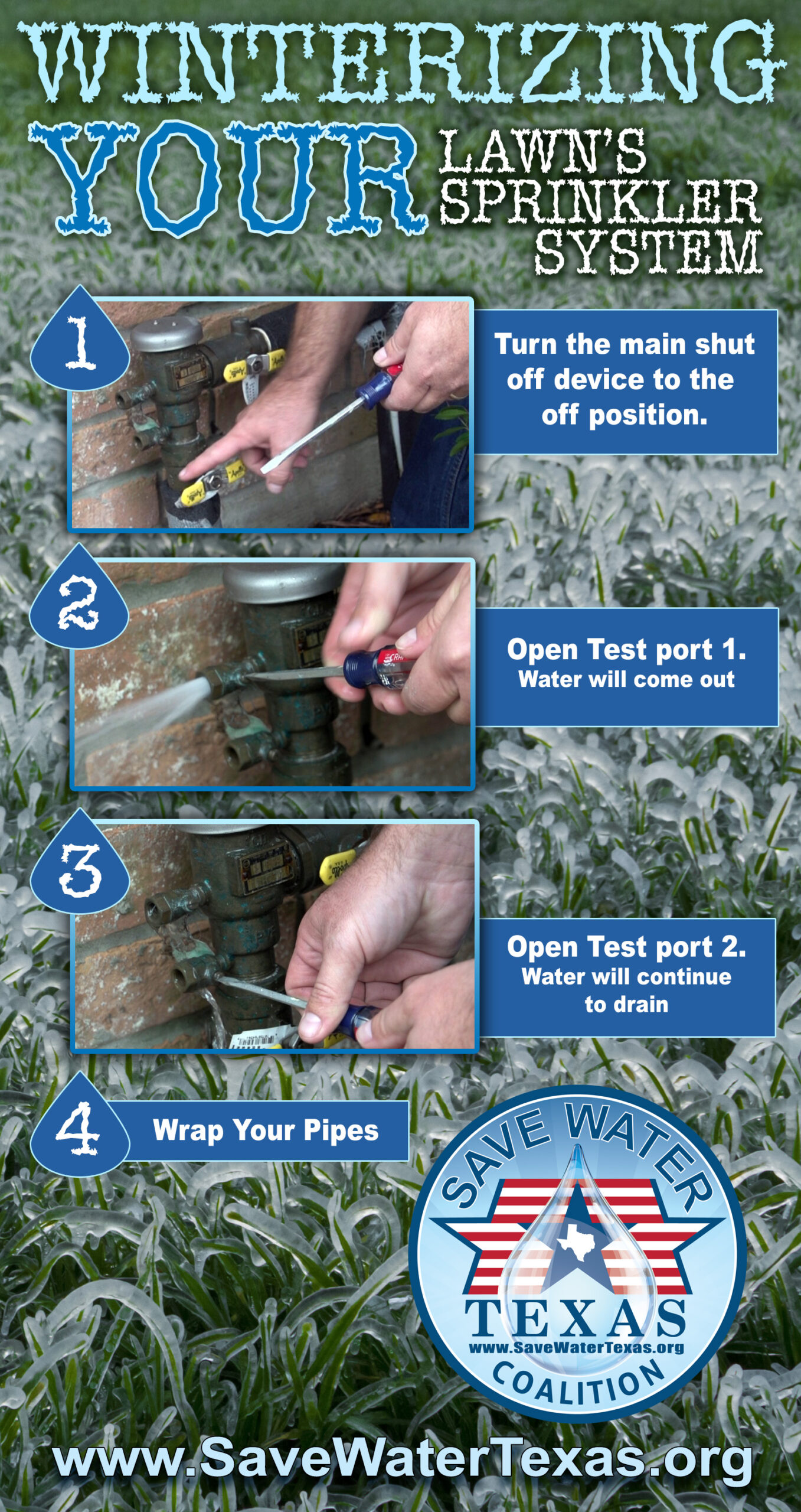
  • If you have an irrigation system, turn off the water to the system at your backflow preventer and drain the system. Be sure to wrap the backflow preventer as well.

Begin your preparations early while supplies are readily available.

Various methods and materials can be used to prevent freeze damage, including foam and fiberglass insulation, prefabricated spigot covers, spray foam insulation, heat tape, heat lamps, and portable heaters. These items are usually available at building supply stores. However, it’s not advisable to wait until the last minute, as they tend to sell out quickly. If supplies are unavailable, improvising with towels and duct tape to insulate vulnerable areas can be an alternative. Turning off the water and draining the lines is the most reliable way to prevent freeze damage, which should always be done for backflow preventers and irrigation systems. Nevertheless, turning off the water isn’t an option for those who need potable water inside their homes. To prevent water from expanding and breaking pipes during a freeze, it’s a best practice to periodically flush the lines through all fixtures inside the house. For small areas directly exposed to freezing temperatures, you can use space heaters, heat lamps, and heat tape, but exercise caution when using devices with extension cords.

STAY VIGILANT

Preparation for a winter freeze is critical, given the high potential for costly damage and loss. Maintaining and checking preventative measures throughout the winter is a best practice. In the event of a cold front, regularly monitoring the weather for arrival time, expected temperature, and the duration of subfreezing conditions is crucial. By staying vigilant and well-prepared, we can minimize the risk of damage and loss resulting from a winter freeze.

HOW INFRAMARK PREPARES

When it comes to safeguarding vital components, water and wastewater facilities share similarities with your home, but a facility failure can have more significant consequences. At Inframark, we adopt a comprehensive approach to winter preparation, considering the WHAT, WHEN, WHERE, and HOW of our facilities. In the fall, we conduct Freeze Protection Audits to identify the most vulnerable components of the system and develop a plan to ensure their protection. The following items are just some of the components we wrap and insulate:

  • Above-ground valves
  • Sensor lines
  • Sight glasses for hydropneumatic tanks
  • Backflow preventers
  • Blow-off valves
  • Chemical feed lines
  • Drip oilers for wells
  • All exposed water lines
  • Heaters in exposed control rooms and cabinets

Our objective at Inframark is to complete the winterization process by October, ensuring that all vulnerable components are properly wrapped and insulated to prevent freezing damage. The Operator conducts a freeze protection audit and submits it to their manager, who then conducts a site walk with the Operator to confirm that all potential freezing hazards have been addressed. Taking proactive measures to prevent freeze damage is far more cost-effective than dealing with the consequences afterward. Winterizing all susceptible areas is essential, ensuring a safe winter season for all.


On behalf of the Texas MUD Leadership Team

Todd A. Burrer
President, MUDs
713-805-9232
Todd.Burrer@inframark.com


Inframark
2002 West Grand Parkway North, Suite 100, Katy, TX 77449

Freezing Temperatures

In Texas, the winter season is generally mild with few extreme weather events. However, it is important to prepare for the possibility of a sudden and severe cold front. Homes and businesses in Texas, particularly in Houston, may not be equipped to withstand a hard freeze. As a result, we would like to remind you of the potential damage that can occur to your pipes during such events. Furthermore, we would like to take this opportunity to inform you of the measures we take to protect your facilities and ensure they continue to operate smoothly during such conditions.

Freezing Temperatures Versus a Hard Freeze

When temperatures fall below 32 degrees Fahrenheit, it is considered freezing. Typically, short periods of freezing temperatures do not result in damage to pipes or facilities. However, when temperatures fall below 30 degrees Fahrenheit for more than eight hours, it is classified as a hard freeze. During a hard freeze, the water in exposed lines and irrigation backflow preventers freezes, which can cause damage to equipment and instrumentation in the water and wastewater facilities.

It is important to note that as water freezes, it expands, which can lead to broken pipes, water loss, and costly repairs. In addition, there may be secondary expenses such as replacing damaged carpet, flooring, sheetrock, furniture, and other possessions. Furthermore, galvanized pipes may not burst during a freeze, but expansion can cause the galvanizing to separate from the pipe and create an area for corrosion to start, which can ultimately result in leaks.

To ensure the protection and uninterrupted operation of our customers’ facilities during a hard freeze, we take a number of preventative measures. We closely monitor weather reports, drain lines, and turn off water to outdoor faucets and other exposed areas. We also educate our customers on how to prepare for a hard freeze and what steps they can take to minimize the risk of damage to their facilities.

How Do I Prepare My Home?

  • All garden hoses should be disconnected from the outside spigots. If you forget and do not drain them, do not move them during freezing temperatures. They may be brittle and crack.
  • All exposed water pipes and outside spigots should be wrapped or covered and then taped. Most home improvement stores have tape, foam wrapping and other products for this purpose. Purchase supplies early as they usually sell out quickly when a hard freeze is coming.
  • Wrap pipes in the attic, especially if they are under an eave leading into the house. While they are not exposed to the outside, they can freeze quickly.
  • All lids on your water meter boxes should be securely closed to keep freezing winds out.
  • If you have an irrigation system, turn off the water to the system at your backflow preventer and then drain the system. Wrap the backflow preventer as well.
  • Start your preparations early while supplies are easier to find!

There are various methods and materials that can be utilized to prevent freeze damage, including foam and fiberglass insulation sized for specific pipes and secured with vinyl and plastic tape, prefabricated spigot covers, spray foam insulation, heat tape, heat lamps, and portable heaters. These items can usually be found at building supply stores, but it is not recommended to wait until the last minute as they may sell out quickly. If supplies are unavailable, improvising with towels and duct tape to insulate vulnerable areas can be an alternative. Turning off the water and draining the lines is the most reliable way to prevent freeze damage, which should always be done for backflow preventers and irrigation systems. However, turning off the water is not an option for those who need potable water inside their homes. To prevent water from expanding and breaking pipes during a freeze, it is best practice to periodically flush the lines through all fixtures inside the house. Space heaters, heat lamps, and heat tape can be used for small areas directly exposed to freezing temperatures, but caution should be exercised when using devices with extension cords.

When and Where Do I Prepare for a Freeze?

Preparing adequately for a winter freeze is imperative, given the high potential for costly damage and loss. Ensuring that preventative measures are in good condition throughout the winter is the best practice. In the event of a cold front, it is crucial to monitor the weather regularly to determine its arrival time, the anticipated temperature, and the duration of sub-freezing temperatures. By staying vigilant and well-prepared, we can minimize the risk of damage and loss resulting from a winter freeze.

How Does Inframark Prepare?

When it comes to protecting vital components, water and wastewater facilities are no different than your home, but a plant failure can have much higher consequences. At Inframark, we take a comprehensive approach to preparing for winter, considering the WHAT, WHEN, WHERE, and HOW of our facilities. In the fall, we conduct Freeze Protection Audits to assess the most vulnerable components of the system and develop a plan to ensure their protection. The following items are just some of the components wrapped and insulated:

  • Above ground valves
  • Sensor lines
  • Sight glasses for hydropneumatic tanks
  • Backflow preventers
  • Blow off valves
  • Chemical feed lines
  • Drip oilers for wells
  • All exposed water lines
  • Heaters in exposed control rooms and cabinets

Inframark’s objective is to complete the winterization process by October, ensuring that all vulnerable components have been wrapped and insulated to prevent freezing damage. The Operator conducts a freeze protection audit and submits it to their manager, who then walks the site with the Operator to confirm that all potential freezing hazards have been addressed. Taking proactive measures to prevent freeze damage is far more cost-effective than dealing with the consequences after the fact. It is essential to winterize all susceptible areas, ensuring a safe winter season.

We hope that this winter will not see a serious hard freeze, but if we do, Inframark is ready.